
1 November 2025
On Friday, October 17, 2025, the 23rd meeting of the Thematic Steering Group (TSG2) of Pillar 2 – Transport of the European Union Strategy for the Adriatic-Ionian Region (EUSAIR) was held in Trieste, at the headquarters of the Presidency of the Autonomous Region of Friuli Venezia Giulia.
The meeting, coordinated by the Pillar Coordinators from Italy, Serbia, and North Macedonia, saw broad in-person participation, fostering constructive dialogue among representatives of EUSAIR countries, European institutions, regional authorities, and transport sector stakeholders.
As part of the activities aimed at implementing the new EUSAIR Action Plan and the newly identified priorities for Pillar 2, the group members discussed progress in two key areas:
Special attention was given to youth involvement in macroregional cooperation processes, highlighted by the presence of Francesco Moroni, member of the EUSAIR Youth Council of San Marino, who emphasized the importance of strengthening youth participation and promoting initiatives to raise awareness of the opportunities offered by EUSAIR.
In this context, the proposal to organize a capacity-building event for young people was welcomed. The event, in collaboration with associations and research groups from the macroregion, could take the form of a hackathon aimed at developing innovative ideas for sustainable mobility in the Adriatic-Ionian area. The initiative may benefit from support through the EUSAIR Facility Point project’s capacity-building resources.
Finally, the main events planned in the 2026 Work Programme of Pillar 2 – Transport were shared, including:
The next TSG2 meeting will be held in Skopje in spring 2026, alongside the Conference on Transport Network Connectivity in the macroregion, organized under the North Macedonian Presidency of EUSAIR.
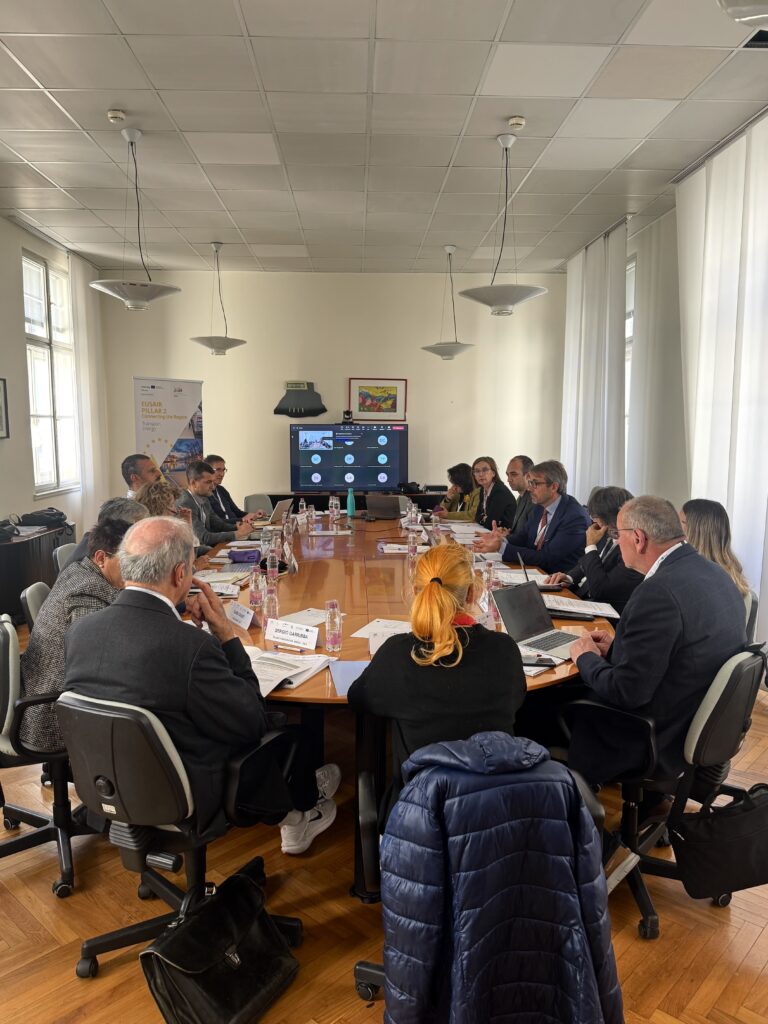

23rd Meeting of the EUSAIR Strategy Thematic Steering Group on Transport
https://www.adriatic-ionian.eu/

The European Union Strategy for the Adriatic-Ionian Region (EUSAIR) addresses shared challenges and opportunities among ten countries. Supported by the Interreg IPA ADRION Programme, the project enhances governance, implements the Strategy and Action Plan, fosters coordination, improves visibility, and builds capacities for data-driven decision-making, while effectively monitoring and evaluating progress throughout the region.