
15 April 2013
On 8th April 2013, in the frame of the project “A geomantic laboratory for the management of the hydrogeological and seismic risk ”it has been held an interesting conference about “Earthquake superficial evidence in Kashmir – 5th October 2005”
Professor Shahab Pervez, from University of Kashmir, presented the current situation of the earthquake zone in Kashmir during the conference at the Department of Mathematic and Geosciences. He described the devastations caused by the seism, the projects for reconstruction already implemented, regarding the recovery of some public buildings, and the ongoing projects.
As is known, the University of Kashmir was destroyed by an earthquake in October 2005, that caused more than 80 thousands victims and left three and a half millions without a house.
The University of Kashmir, which had 110 dead people among its students and whose structures were seriously damaged by the earthquake, asked the University of Trieste and the President of Region Friuli Venezia Giulia for a collaboration concerning the education of experts in the management of the hydrogeological and seismic risk.
In the third phase of the project, two more young researchers from University of Kashmir (AJKU) came to Trieste together with Prof. Pervez, who expressed thankfulness to the University of Trieste and Region FVG for this initiative.
Replying to Prof. Pervez, Architect Luciano Pozzecco, from Central Directorate of Culture, Sport, International and European Relationship of RAFVG, described how, in the framework of the initiatives for the International cooperation of Region Friuli Venezia Giulia, it was financed the project of the Department of Mathematic and Geosciences of the University of Trieste, whose objective is the realization of a laboratory for geomantic at the University of the earthquake city. The financing of the third project phase was realized with the collaboration of INFORMEST.
This laboratory, attended by experts from Trieste, will be a link with the local administration of the earthquake zone and provide assistance in the evaluation of damages and in the management of aids both from the Government of Pakistan and from other countries of the international community.
In 2007 and 2009, two additional groups of researchers attended a training in Trieste about the hydrogeological risk. Now two of them run courses about the applications of Territorial Informative Systems at their universities.
The efficiency of the local bodies in Friuli, helped by the regional structure in the management of assistance and in the planning of the reconstruction after the event on the 6th of May 1976, was an example for Italy and it was perceived overseas since it was referred to the scientists of the Center for Theoretical Physics. The University of Kashmir has, therefore, contacted the Italian Embassy in Islamabad asking for a transference of Friuli experience in favour of the Hymalaian country, keeping still in consideration the environmental and social differences.
That could happen just with an exchange of view among the players of the reconstruction of the post-seism ’76 (in a few days there will be the 37th anniversary) with some of the responsibles for the reconstruction in Kashmir.
In this sense the Department of Mathematic and Geoscience has suggested a turn of events with the main regional experts of geology and of the Oceanographic Institute (OGS) for an exchange of experiences and for the definition of an education programme for researchers in Kashmir.
Professor Franco Pettenati of OGS was particularly interested in a correlation between surface evidences and instrument parameters for a study of historic earthquakes.
Professor Giorgio Poretti underlined that this project has started a serie of initiatives and collaborations with University of Kashmir, with Karakorum International University and with Bahria University in Islamabad. A project for the realization of a permanent networks of satellite receivers GPS, in order to determine the degree of tectonic movements of the crustal plate, was financed by the Ministry for Foreign Affair.
Other projects, like the one for the monitoring of the banks in the area where the dike on Indo is being built or the one concerning the use of numerous warm sources for the production of electric energy, are waiting for financing.
This regional project has supported the involvement of researchers from University of Trieste in international projects of the Commission Ev-K2-CNR, like the project SEED for the study of the unstable areas of the National Park in Central Karakorum.
Besides the Department of Mathematic and Geosciences of the University of Trieste, the national Oceanographic Institute (OGS) and the regional bodies, which deal with the management of the territory and prevention of calamities, participate to the project, financed through INFORMEST.
Moreover, it has to be reminded that Kashmir territory is divided into two administrative parts, respectively from Pakistan and India, and that after fifty years of conflicts the two governments are trying o find a solution for a stable reunification.
The earthquake in 2005 caused damages and deaths from both sides of the border and a cross-border civil protection system could be a first input for an agreement.
The zones damaged by the earthquake in 2005 were subject of scientific analysis by Ardito Desio, Antonio Marussi and their successors in the Commission Ev-K2-CNR, that are working in the establishment of the Karakorum National Park (see aforementioned project SEED) and of the Park of Peace along the “no-conflict” line in the Siachem glacier, as well as climate studies and volumetric analysis of glaciers.
poretti@univ.trieste.it
N.B. A full documentation of the earthquake zone is available.
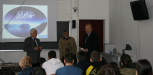
Comparing natural disasters (Friuli ’76 and Kashmir 2005) and scientific collaboration between Region FVG and Kashmir